 Capacity Ledger
Who Gets Out of New Chemicals Review Without an Order?
EPA's statements of findings for May reached the Federal Register on Tuesday with two entries on it. The unrestricted exit from section 5 review ran 267 determinations in fiscal 2019 and 18 so far in fiscal 2026, and of the 106 fiscal-2026 reviews that ended in permission to commercialize, 88 came with an order attached.
EPA's statement of findings for May 2026 reached the Federal Register on Tuesday morning. It runs two entries.
One is a maleated polyalkene filed as P-26-0024, identity generic because the submitter claimed the specific name confidential. The other is a modified Saccharomyces cerevisiae for improved production of ethanol, case J-26-0001.
That is the complete list of new chemical substances and significant new uses EPA found not likely to present an unreasonable risk during the month of May. Two.
"How often does a new chemical still get out of section 5 review with nothing attached to it?"
The two exits
Everything that reaches the market out of a PMN, MCAN or SNUN leaves review through one of two doors.
- Not likely to present an unreasonable risk. EPA issues a section 5(g) notice, sometimes puts a SNUR behind it, and the substance goes to market with no order binding the submitter. This is the finding those monthly Federal Register notices exist to publish.
- An order. Insufficient information, may present an unreasonable risk, substantial production or exposure, presents an unreasonable risk: all of them land on a section 5(e) or 5(f) order with a significant new use rule following it.
The first door used to be wide open. In fiscal 2019 EPA completed 402 determinations on notices, and 267 of them, two in three, came out unrestricted (chart below).
Fiscal 2026 through August 1: 134 completed, 18 unrestricted.
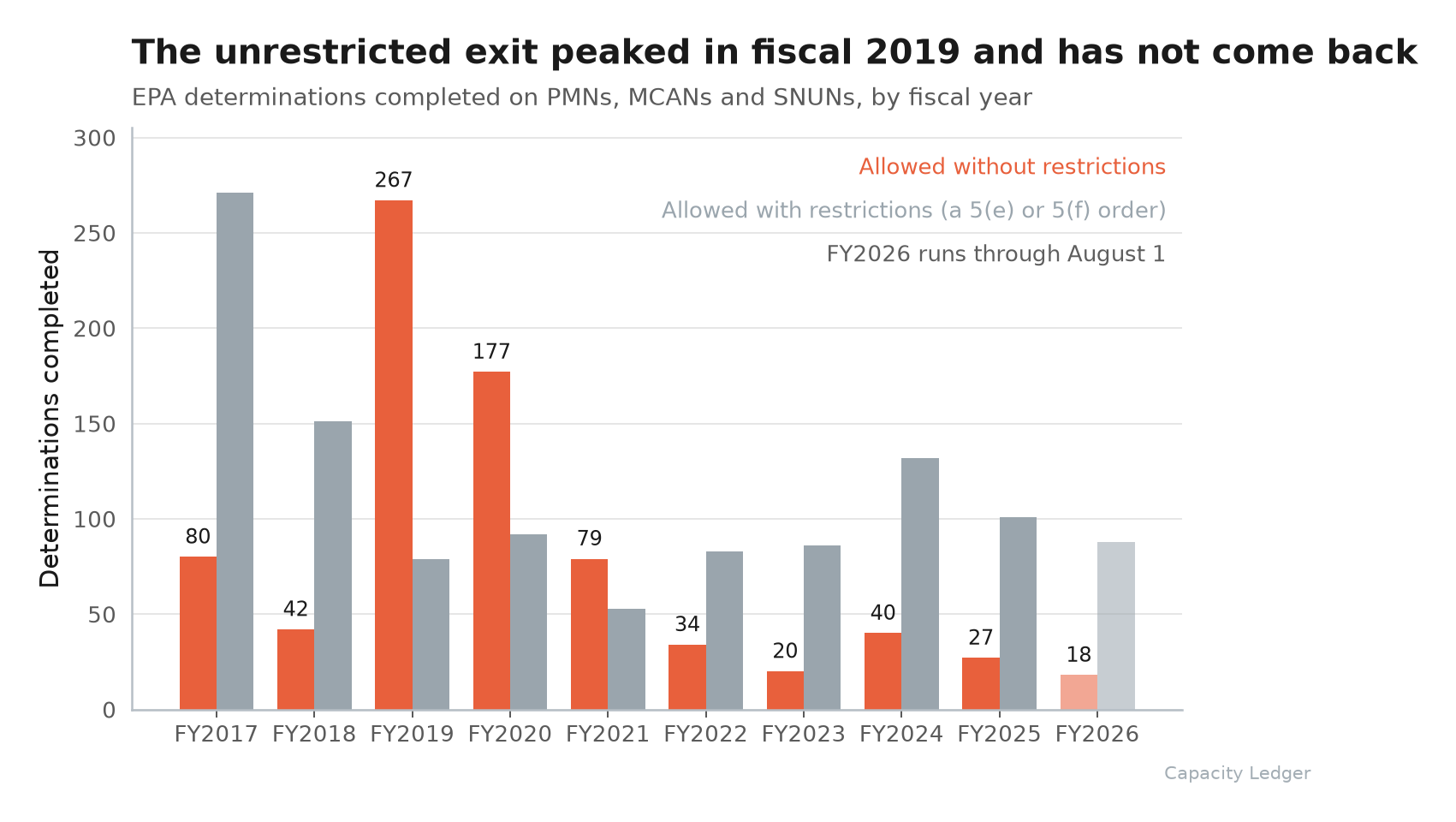
Strip out the withdrawals and the comparison gets sharper. Of the 106 fiscal-2026 determinations that ended in permission to commercialize something, 88 carried an order.
What closed it
The fiscal 2019 number had a specific mechanism behind it, and the mechanism is gone.
EPA had been issuing not-likely findings that leaned on a proposed SNUR. The agency would conclude the intended conditions of use were fine, propose a rule to catch everything outside them, and clear the substance on that basis.
On March 29, 2021 it said it would stop, and the wording is flat: "EPA will stop issuing determinations of 'not likely to present an unreasonable risk' based on the existence of proposed SNURs."
Where review finds a use that may present an unreasonable risk, or where the agency lacks the information to rule one out, "the agency will issue an order to address those potential risks."
Now look at fiscal 2017 in that chart, before any of this. 80 unrestricted against 271 orders.
The wide door was a two-year window that closed five years ago. If your mental model of how a new grade clears US review was formed in 2019, it was formed on the exception.
What that does to a launch
Three things worth holding onto, if you are the one carrying a new substance through:
- An order binds the submitter, and the SNUR published behind it carries the same conditions of use to every other manufacturer and importer. The restrictions do not stay inside your four walls. They follow the molecule to whoever handles it next.
- EPA counted 428 active notice cases on August 1. 211 were in risk assessment, 67 in risk management, 73 waiting on information from the submitter, and 77 parked waiting for a submitter to sign an order.
- Notices of commencement, the filing that goes in when manufacture or import actually starts, ran 289 in fiscal 2017 and 78 so far in fiscal 2026. Fewer new substances are reaching the point of being made.
And the public record of who got through runs a quarter late. May's findings were signed on August 19 and printed on August 25, 86 days after the month closed.
April's took 89.
So the register you would use to watch what a competitor cleared is telling you about the spring.
Final Thoughts
None of this says EPA is refusing new chemicals. 23 determinations in the program's entire history since 2016 landed in the not-allowed column, ten of them in fiscal 2024, and the Fifth Circuit vacated nine of those ten in March of that year.
Things get through. They get through carrying paper.
An order, a SNUR, conditions of use that travel downstream to customers who never filed anything and will read them for the first time in a safety data sheet. That is the assumption to price into a launch timeline, and it has been the right one since March 2021.
The monthly notice with two names on it is just the clearest way to see it.
Thanks for reading.