 Capacity Ledger
Why Your USP Glycerin Has a Stockyards Address
Vantage's 34-acre Chicago site calls itself the nation's largest domestic merchant producer of oleochemical fatty acids. It is also where the first US-made ICH Q7 glycerin comes from, and the hydrolysis that makes one makes the other.
The Union Stock Yards ran from 1865 to 1971, and when they closed, the ground underneath them became an industrial park.
One tenant on that ground still splits animal fat for a living.
Vantage Specialty Chemicals operates a 34-acre site in Chicago's Stockyards neighborhood that began as a small rendering operation, went to Unilever in 1985, and became the original Vantage manufacturing hub in 2008. By the company's own count it has taken more than $225 million of capital since the Unilever purchase, and it runs today with more than 100 people across production, maintenance, utilities, R&D, quality and commercial support.
You have probably been reading about this site all year without anyone telling you where it is. Vantage filed the antidumping and countervailing duty petitions on certain fatty acids from Indonesia and Malaysia on January 28, 2026, and the preliminary antidumping duties in the Indonesia case, A-560-848, became applicable on September 22.
The petitions are one story. The reactor is a different one.
"When one American site splits most of the country's merchant fatty acid, what else comes off the same equipment?"
What Thirty-Four Acres in the Stockyards Does
Vantage describes Chicago as its "world-scale vegetable oil / tallow splitting plant" and calls itself the nation's largest domestic merchant producer of oleochemical fatty acids and derivatives from that Midwest site. Those are the company's words, and they are the kind of claim this industry checks.
What the site has added since 2008 tells you more than the superlative does. A food-grade kosher glycerin facility. A fatty acids separation facility. Expanded tank storage. Railcar and road both reach the fence.
The feedstock slate is the quiet part: vegetable oils and animal fats through the same plant, which is a genuinely useful thing to own when your palm-origin lanes are under a trade case and your tallow is domestic.
The Co-Product Is the Point
Splitting a fat is hydrolysis. Three moles of water break the tri-ester bonds of one mole of triglyceride, and what comes back out is three moles of fatty acid and one mole of glycerol (chart below).
The commercial route, Colgate-Emery, runs at roughly 250 C and 50 bar, and it has been the workhorse for decades.
So the glycerin comes off the same reactor as the acid.
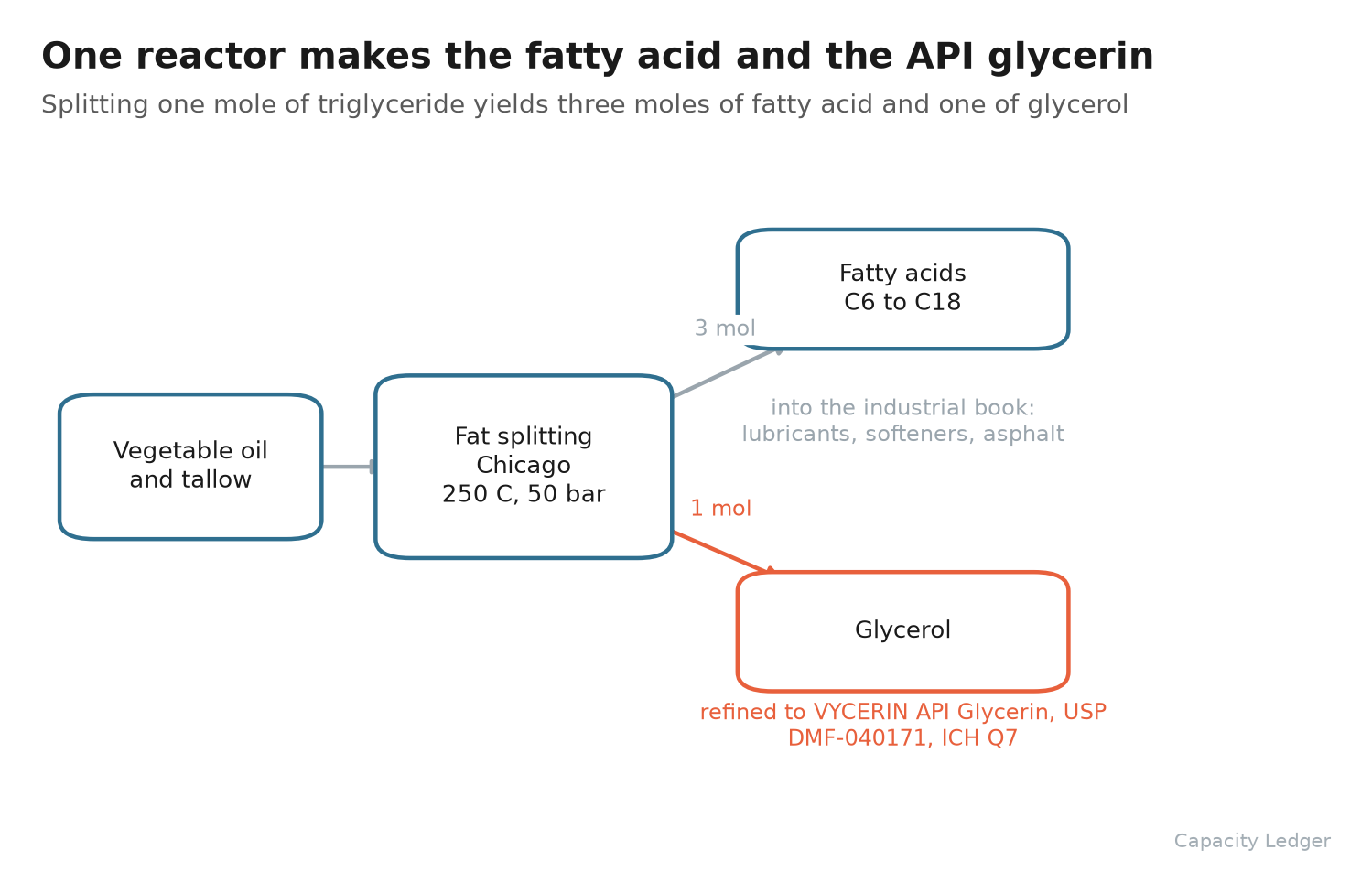
Plenty of splitters treat that stream as something to sell crude and forget. Vantage pushed it the other way, which is the part of this site worth your attention.
The company calls itself the leading manufacturer of glycerin in the US, with more than thirty years at it, and says VYCERIN API Glycerin, USP is the first API-grade glycerin manufactured in the United States to ICH Q7 standards. On February 27, 2025 it filed the FDA Drug Master File that backs the claim, DMF-040171, so a drug formulator can cite the material directly instead of working an exception.
Tom Giese, Vantage's EVP of Performance Solutions, put it as giving customers a way to use glycerin "as an active ingredient without relying on atypical API exceptions."
Two of the company's plants are FDA-registered API facilities: Chicago, and Englewood, Ohio.
What a Splitter Has to Be Certified For
Now, the reason this is hard to copy has very little to do with the reactor.
One site feeding crayons, asphalt, fabric softener, food release agents and pharmaceutical actives has to satisfy every one of those auditors at the same time, on the same equipment, in the same year. The Chicago stack, per the company:
- OSHA VPP Star status since 2006
- ISO 9001 since 1993
- FSSC 22000 since 2014
- FDA-registered API facility, ICH Q7 cGMP verified
- RSPO Mass Balance certified
That is five audit regimes standing on one 34-acre parcel, and the oldest of them is thirty-three years old.
A greenfield competitor can buy a splitter. The 1993 certificate is not for sale.
Final Thoughts
Most of the attention on US fatty acids this month went to deposit rates and scope language, which is fair, because that is where the money moved on September 22.
The thing that gets missed in a trade docket is that molecules travel in pairs. If you buy USP or API glycerin and you have been treating it as a commodity with a dozen interchangeable origins, the diagram above is your reminder that a meaningful share of the domestic supply is a byproduct of a business you have been reading about under a different name.
And it sits on the ground the Stock Yards left behind, which is either a nice piece of continuity or just a very good rail connection that nobody ever had a reason to give up.
Thanks for reading.