 Capacity Ledger
Your Antimony Alternative Now Has an American Half
Synthomer sold William Blythe for 30 million pounds in May 2025. Fifteen months later the 1845 Accrington inorganics house is the smaller side of a 160 million dollar group whose largest region is North America, and the flame retardant line it carries is the one sold as an antimony trioxide replacement.
William Blythe was a Scottish chemist who came out of the University of Manchester and set up in Accrington in 1845 to supply the Lancashire textile trade. His company's first patent, granted in 1854, was a route to sulfuric acid.
The firm is still on that site. Roughly 85 people, inorganic derivatives of tin, iodine, copper, zinc and tungsten, sales into 40-plus countries.
On August 12 it agreed to combine with a company from Brazil, Indiana.
"What changes for a buyer when a single-site UK supplier suddenly has a plant in Indiana?"
The Tin Half of Your Flame Retardant
Accrington's flame retardant line is called Flamtard, and it started in 1989 as a development programme with Alcan alongside a sodium metaperiodate plant.
Two grades carry it. Flamtard H is zinc hydroxystannate, CAS 12027-96-2, for systems processed below 220 °C: PVC, elastomers, thermosets.
Flamtard S is zinc stannate, thermally stable above 400 °C, which is what puts it into polyamide and the other engineering polymers.
Both do the same two jobs at once. Tin goes into the gas phase and scavenges the halogen radicals coming off the decomposing PVC or the halogenated additive, and the condensed phase does the smoke suppression.
William Blythe's own product pages call both of them non-hazardous, antimony-free synergists. Flamtard H is "commonly used as an ATO (Antimony Trioxide) replacement," and Flamtard S is "commonly used as part of an ATO replacement solution in polymer systems."
That word is the reason this is worth your morning. We wrote on August 18 about the November 27 expiry of Beijing's suspension of its antimony export ban, and about what a domestic smelter looks like when it finishes nine furnaces into a price trough. If you have been running substitution math since that date got fixed, Flamtard is one of the answers on the supplier side of it, and its owner just changed shape.
Fifteen Months, Both Continents
Synthomer announced the sale on 6 May 2025. The price was £30m, against £54m of 2024 sales and £4m of adjusted EBITDA, on a business that had been non-core since the October 2022 strategic review.
The buyers were the management team and H2 Equity Partners. It completed at the end of that month.
Fifteen months later the same owner put it together with Metals and Additives LLC. The announced combined revenue is over $160m, split roughly 50% North America, 30% Europe, 20% Asia-Pacific.
Run those two numbers against each other and the shape is clear (chart below).
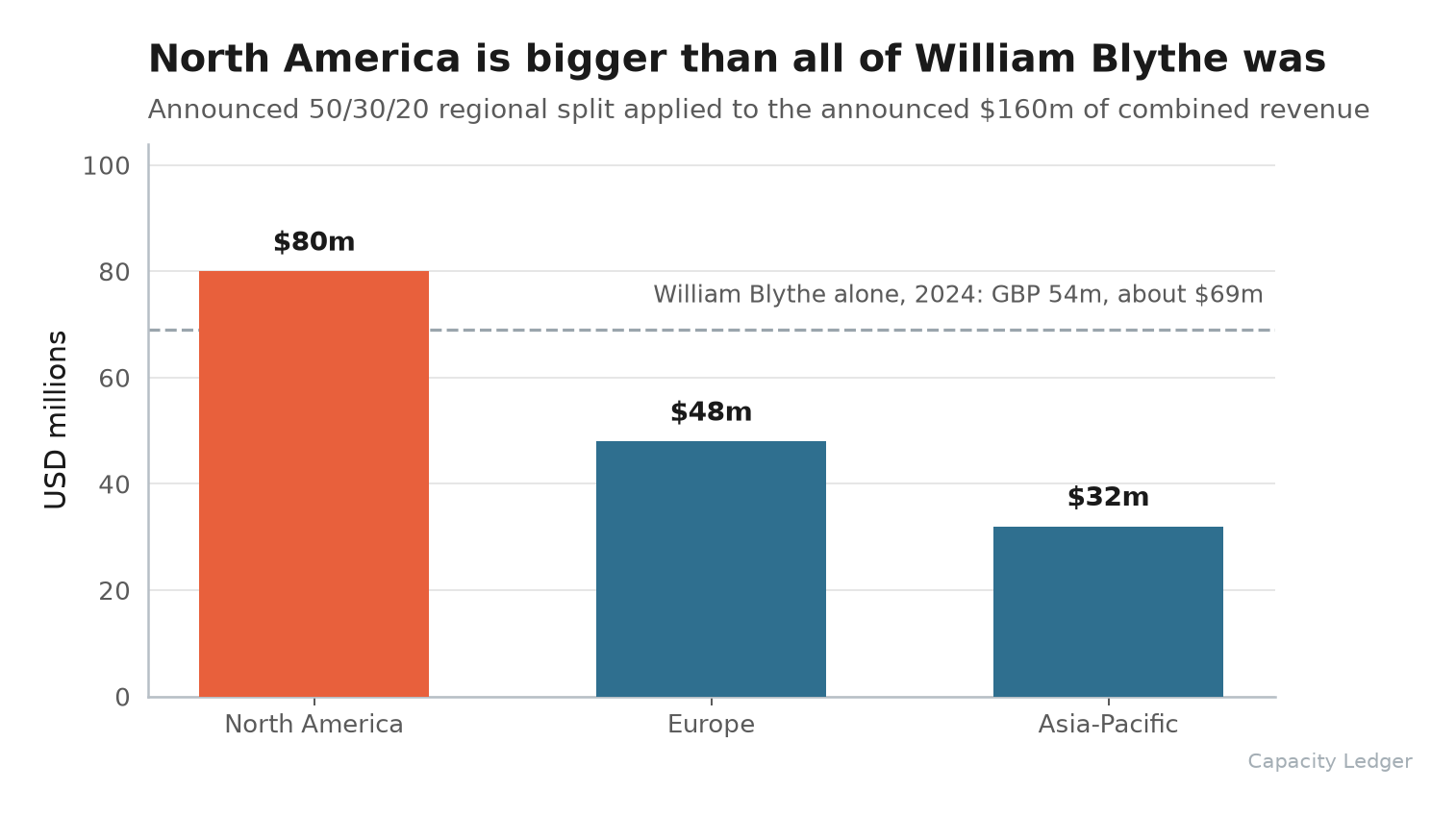
£54m at 2024's average sterling rate of 1.2781 is about $69m, so Accrington accounts for something like 43% of the group and the American side brings roughly $91m. Those are different bases, a 2024 audited year against an announced combined figure whose period nobody has stated, and we would not put them in the same column of a model. As a read on which half is bigger, the gap is wide enough to survive the imprecision.
North America is now the group's largest region. William Blythe's own manufacturing is in Lancashire.
What Brazil, Indiana Actually Runs
MAC is four businesses: Polymer Additives Group, Addenda, OMNI Oxide, and Reedy Chemical Foam.
Addenda publishes the most about itself. Headquarters in Indianapolis, production at 10665 North State Road 59 in Brazil, Indiana, ISO 9001 across every location, and a plant that doubled in a 2005 expansion with further capacity added in 2008 and 2011. The catalogue is a list of things a compounder buys by the drum:
- lead stabilizers, sold as addiBase and addiThal
- battery additives under addiBatt-Tetra
- flame retardants and smoke suppressants
- basic magnesium carbonate (addiCarb-BMC) and basic zinc carbonate (addiCarb-BZC)
Reedy Chemical Foam is the one with the travel history. Founded in Keyport, New Jersey in 1989 by Michael Reedy, moved to Charlotte in 2015, and headquartered in Brazil, Indiana since 2019, where it makes the Safoam endothermic foaming and nucleating agents in pellet and powder form.
OMNI Oxide is the oldest connection in the group. Addenda's own site still carries the notice from April 20, 1999 announcing an alliance between the two, sharing the Brazil plant and the Indianapolis office, with OMNI described then as a North American producer of lead oxides for the battery and electronic glass industries out of four US plants. That description is twenty-seven years old and we are reporting it as history, not as a current capacity statement.
Read the two catalogues side by side and the overlap is metals chemistry sold into polymer processing. Zinc and tin on one side of the Atlantic, lead and magnesium and zinc carbonates on the other, both ending up in someone's compounding line.
Final Thoughts
Nothing was built on August 12. No tonne of anything got added to the ledger, and neither company published a capacity number with the announcement.
What moved is jurisdiction. A Flamtard grade that a US formulator could previously only buy out of Lancashire now sits inside a group with a plant in Indiana, a US-weighted revenue base, and every incentive to make the American half of that supply chain do more work. Whether any Flamtard tonnage ever gets made in Brazil, Indiana is a question for a later filing, and it is the right question to have on your list.
Give the 181-year-old part of this its due. A firm that got its start selling sulfuric acid to cotton mills has spent the last decade putting up a hydrothermal nanoparticle plant, a 50-tonne graphene oxide process, and a 250 m² applications lab.
Longevity in inorganics is a function of being willing to retool, and Accrington keeps doing it.
Thanks for reading.