 Capacity Ledger
Your Chemical Distributor's Margin Is a Public Number
BLS publishes a monthly index of the gross margin chemical wholesalers take between acquisition and sale. It set an all-time high in June, has fallen three straight months since, and still sits 20.0% above where it was a year ago, against 8.8% for basic chemicals at the plant.
Four separate times in yesterday morning's producer price release, the Bureau of Labor Statistics lists the same index among the month's declines.
Final demand services. Services for intermediate demand. Stage 4, then stage 1.
The line reads "chemicals and allied products wholesaling," and the release never says by how much. It only says it fell.
The size of the move is public anyway, in a series almost nobody in chemical sourcing pulls.
"What does the distributor add between the plant gate and your dock, and who measures it?"
What 4246 Actually Measures
BLS does not price what a chemical distributor sells you. It prices what the distributor adds.
The Handbook of Methods is direct about why: the PPI "views wholesalers and retailers as suppliers of distributive services (rather than goods)," so the output of those industries "is best represented by tracking the differences" "between selling prices of goods and their acquisition prices." BLS "therefore tracks the average changes in gross margins received by wholesalers and retailers."
The published arithmetic is one line: Current Selling Price - Current Acquisition Price = Margin Price.
Two consequences, and both matter before you quote the series to anyone:
- Two prices move, so the index swings harder than either one. BLS says these margin indexes "are prone to volatility, often moving more than 5 percent on a monthly basis."
- Any lag between acquisition and sale lands in the margin. Acquisition costs that move ahead of selling prices widen the spread, and selling prices that move first narrow it.
The series is PCU42464246, chemicals and allied products merchant wholesalers, monthly, not seasonally adjusted, based on January 2021 equals 100. It starts in February 2009 and it updated yesterday at 8:30.
June Was the Best Month the Series Has Had
The index printed 160.747 in June 2026, the highest level in its 212 months.
The twelve months into that peak were +29.7%, the largest twelve-month increase anywhere in the series. So the distributor layer had its record year in the same window the plant index printed its own all-time high.
September came in at 146.245. That is well off the top, and only six months in seventeen years have ever printed above it.
All six of them are March through August of this year.
Three Months Down, and Still Ahead of the Plant
September took 2.8% off the index, the third consecutive monthly decline.
Those three months together took 9.0% off, which is the fourth-steepest three-month window the series has produced. The three steeper ones all sit in 2010.
July alone was -5.7%, the third-largest single month in the file.
So the spread is compressing fast. It is also compressing alone.
The same release put margins for final demand trade services up 1.4% in September, and the all-nondurable-goods wholesaling index rose 1.9% to a series high of its own. Chemicals is the line going the other way, which is how it ends up named four times in a release about margins rising.
Set the margin index against basic chemical producer prices on one base and the shape of 2026 gets clearer (chart below). Measured from January 2021, the margin index stands at 146.2 and the plant index at 139.0.
On that base the margin index has now printed above the plant line for ten straight months. Back to the start of 2021, which is as far as a common base reaches, it never once managed more than two in a row.
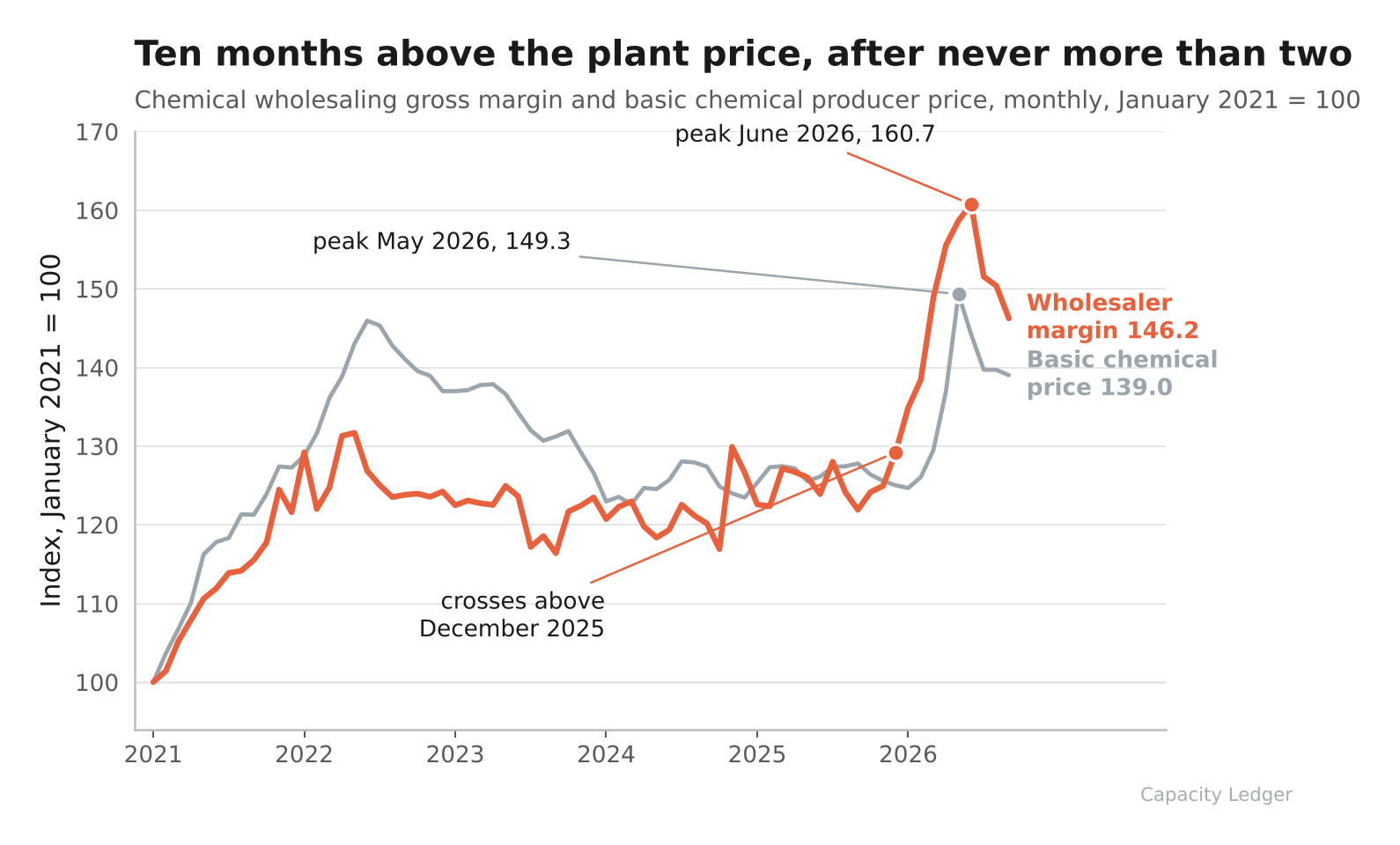
The peaks are a month apart. Basic chemicals topped out in May, the distributor spread in June, and the gap between them is still 7.2 index points.
Final Thoughts
None of this says a distributor is gouging anyone. A wholesaler selling inventory bought three months earlier genuinely books the lag as margin, and the same arithmetic runs against them on the way down, which is what the last three prints are.
What it does say is where the increase currently sits. Year over year the chemical wholesaling spread is +20.0% and the basic chemical price is +8.8%, so the layer between the plant and your dock has widened at more than twice the rate of the layer that makes the molecule.
That is a reasonable thing to put in front of a distributor at renewal, and the two series cost nothing to pull. The October print lands November 13.
Thanks for reading.