 Capacity Ledger
Your Gas Supplier Is Building for Someone Else
Air Liquide's half-year landed this morning. Electronics took more than a third of a record 2.9 billion euros in investment decisions, the pipeline business that sits inside chemical plants shrank, and one of five announced US plants serves a chemical site.
Every large chemical site has an industrial gas supplier living inside the fence. Nitrogen for inerting, oxygen, hydrogen, sometimes syngas coming over the fence from a partial oxidation unit that exists only to feed you.
You negotiated that supply once, on a long-term contract, and then stopped thinking about it.
Air Liquide published its half-year this morning, and it is worth thinking about again.
"Who is your gas supplier actually building for?"
A Billion Dollars, One Chemical Customer
The release names five US plant commitments this year. They add up to more than $1.03 billion of announced money, and one of them serves a chemical company (chart below).
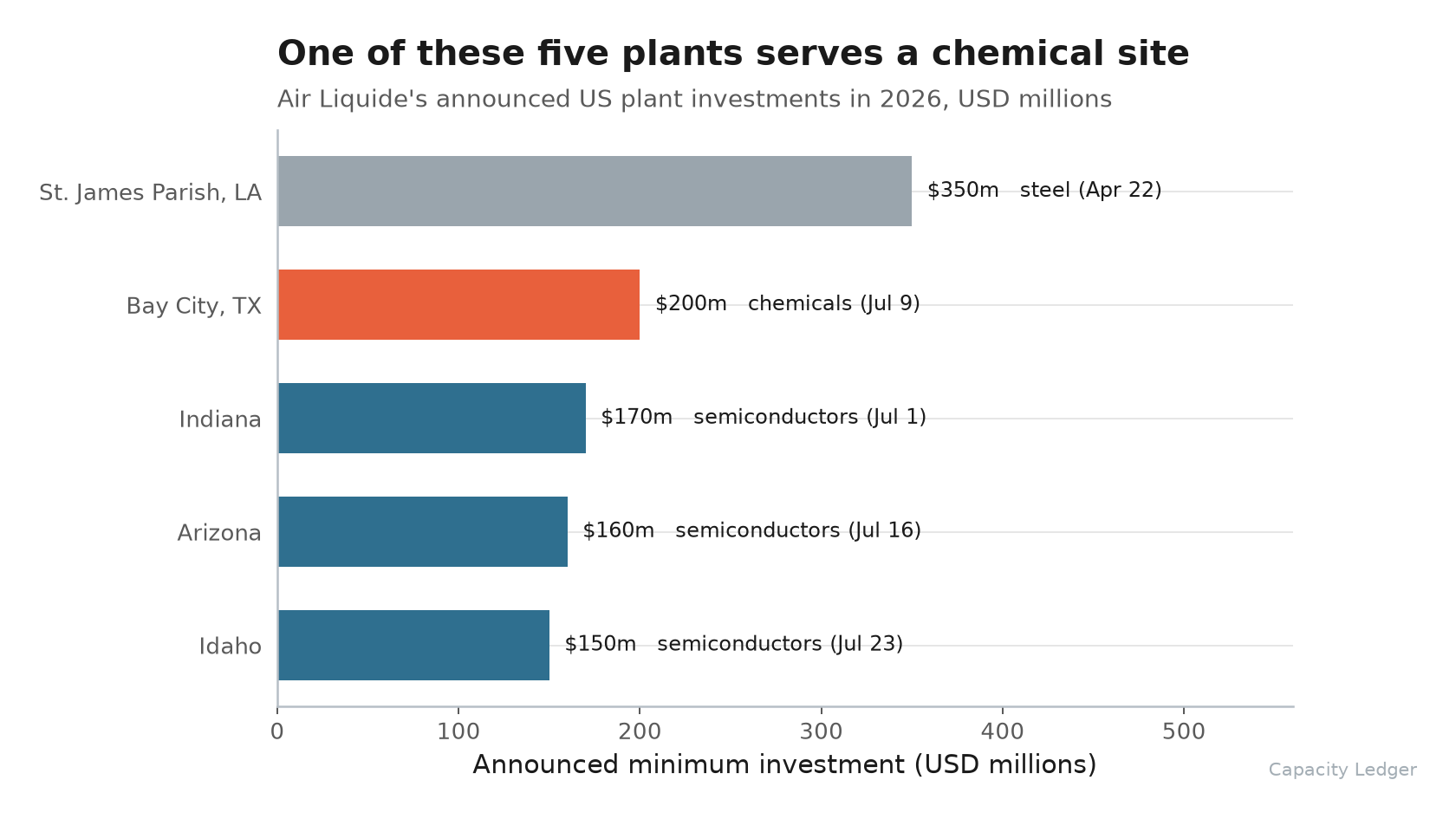
That one is Bay City, Texas. More than $200 million for a high-efficiency partial oxidation unit at Oxea's site, making syngas and low-carbon hydrogen for oxo-alcohols and performance chemicals, startup at the beginning of 2029.
The other four went elsewhere. $350 million in St. James Parish, Louisiana, for oxygen, nitrogen and argon into Hyundai-Posco's future low-carbon steel plant. Then $480 million across three semiconductor sites: Indiana for SK hynix's first US fab, Arizona for an advanced-node maker, Idaho for a memory producer. All three landed inside twenty-three days this month, and all three start up in 2028.
The Pipeline Business Is Flat, and the Gulf Is Carrying It
Large Industries is the segment that sits inside refineries and chemical complexes. It did 3,703 million euros in the half, and on a comparable basis it shrank 0.6%.
Air Liquide's own explanation of that number is the useful part: "very strong demand from customers on the pipeline networks of the US Gulf Coast almost fully offset weak demand in Europe and Asia."
Europe was down 2.6%. Asia Pacific was down 3.0%. The Americas were up 7.0%.
So the Gulf Coast is the one place on earth where the gas industry sees chemical and refining demand pulling harder, and it is pulling hard enough to cancel out two continents.
Electronics grew 6.2% over the half and 9.5% in the second quarter alone.
Where the Capital Committee Went
First-half investment decisions hit a record 2.9 billion euros, up 27% on last year.
Electronics took more than a billion of that, which is 46% above what Air Liquide decided on Electronics in all of 2025. The Americas took 1.5 billion euros, more in six months than the region got in the whole of last year.
Then the number that should matter most to a buyer.
The investment backlog is a record 6.0 billion euros across more than 70 projects, and the company describes it as "evenly balanced between Large Industries and Electronics."
Electronics is 1,317 million euros of revenue. Large Industries is 3,703 million. A business roughly a third the size is now taking half the project pipeline.
That is what you are bidding against when your on-site supply comes up for renewal. A fab, with a construction schedule and a capital committee already pointed at it.
What It Costs You Now
Industrial Merchant, the bulk and cylinder business most specialty sites buy from, grew 3.2% on a global price effect of +4.2%, with volumes only slightly up once helium is stripped out.
That is a price-led half in a business with no volume recovery underneath it. If your bulk nitrogen or argon renewal came in high this year, the company's own numbers say the increase was doing the work.
Helium is its own wound. Air Liquide puts the volume hit down to "the interruption of a helium source following the Middle East conflict," which is the same Hormuz thread we have been pulling all week on benzene and on LNG, surfacing now in a specialty gas.
Final Thoughts
Capital allocation is the one forecast that costs real money to get wrong, which is why it is worth more than the forecasts that don't.
Air Liquide has looked at the next five years, put a record amount on the table, and pointed most of its new US capacity at chips. The chemical industry gets Bay City and a very busy Gulf Coast pipeline network that already exists.
None of that is a verdict on your business. It does tell you which queue you are standing in the next time you need an on-site unit built, and roughly how long the line is.
Thanks for reading.