 Capacity Ledger
Your Korean Superabsorbent Now Enters at Zero
Commerce closed the second administrative review of the antidumping order on Korean SAP this morning at 0.00 percent. The published all-others rate is still 26.05, LG Chem has not posted a deposit in thirteen months, and the tonnage on the line has already answered.
Commerce has published two rate tables for case A-580-914.
The one from December 2024 says 26.05 percent. The one that published this morning says 0.00.
Same order, same company, same product.
The antidumping order on superabsorbent polymers from Korea has examined exactly one producer in its life, LG Chem, and today's final results are the second review in a row to find it sold nothing below normal value. The deposit has actually been zero since August 12 last year.
The 26.05 is what still comes up when anyone pulls the case.
"If the order stopped collecting thirteen months ago, what is it still doing to your landed cost?"
What went final this morning
The 2023-2024 review covers entries from December 1, 2023 through November 30, 2024. LG Chem's weighted-average margin: 0.00 percent, unchanged from the May 22 preliminary, on which no interested party filed a single comment.
Three things follow from that, and only one of them is the headline:
- Assessment. Commerce will instruct CBP to liquidate those entries "without regard to antidumping duties." Everything that came in across that twelve months carried a 17.64 percent deposit, because the higher rate did not apply until December 27, 2024. That cash comes back.
- The clock. Assessment instructions go out no earlier than 35 days after publication. If someone files a timely summons at the Court of International Trade, liquidation waits out the injunction window, 90 days from today.
- The deposit going forward. Zero for LG Chem. 26.05 percent for any exporter and producer pair the order has never looked at, which is the rate the original investigation set and the only rate most people ever see.
The rate that moved is the one nobody deposits against
Worth knowing how 26.05 got there, because the whole argument was about a product spec.
Commerce's October 2022 final determination came in at 17.64 percent, built on a model match hierarchy that graded SAP by centrifugal retention capacity in 4 g/g bands and then added absorbency under pressure and permeability as separate characteristics. Which is to say, Commerce agreed to compare Korean SAP to Korean SAP the way a hygiene converter writes a spec.
The Ad Hoc Coalition of American SAP Producers, meaning BASF, Evonik Superabsorber and Nippon Shokubai America, appealed exactly that. The CIT agreed with them in March 2024, Commerce dropped AUP and PERM on remand and widened CRC to 6 g/g, and the amended final landed at 26.05 percent in December 2024.
So the fight was over whether three absorbency parameters are commercially significant enough to define a product. Winning it added 8.41 points.
And it bought nothing. The first administrative review had been running since February 2024, and it came back at 0.00 on August 12, 2025.
A third more tonnage inside a year
The order names HTSUS 3906.90.5000, and the six-digit parent is where the public monthly data sits. It runs broader than the scope, though not by much on this lane: Commerce put 2021 subject imports from Korea at 71,546,132 kg against 76,328,147 kg on the whole Korean line that year, or about 94 percent of the weight.
Run that line either side of the zero deposit and it moves (chart below). The twelve months to July 2025 carried 30,499,064 kg.
The twelve months to July 2026 carried 40,723,682 kg, up 33.5 percent, with June 2026 the largest month in the series at 4,308,446 kg.
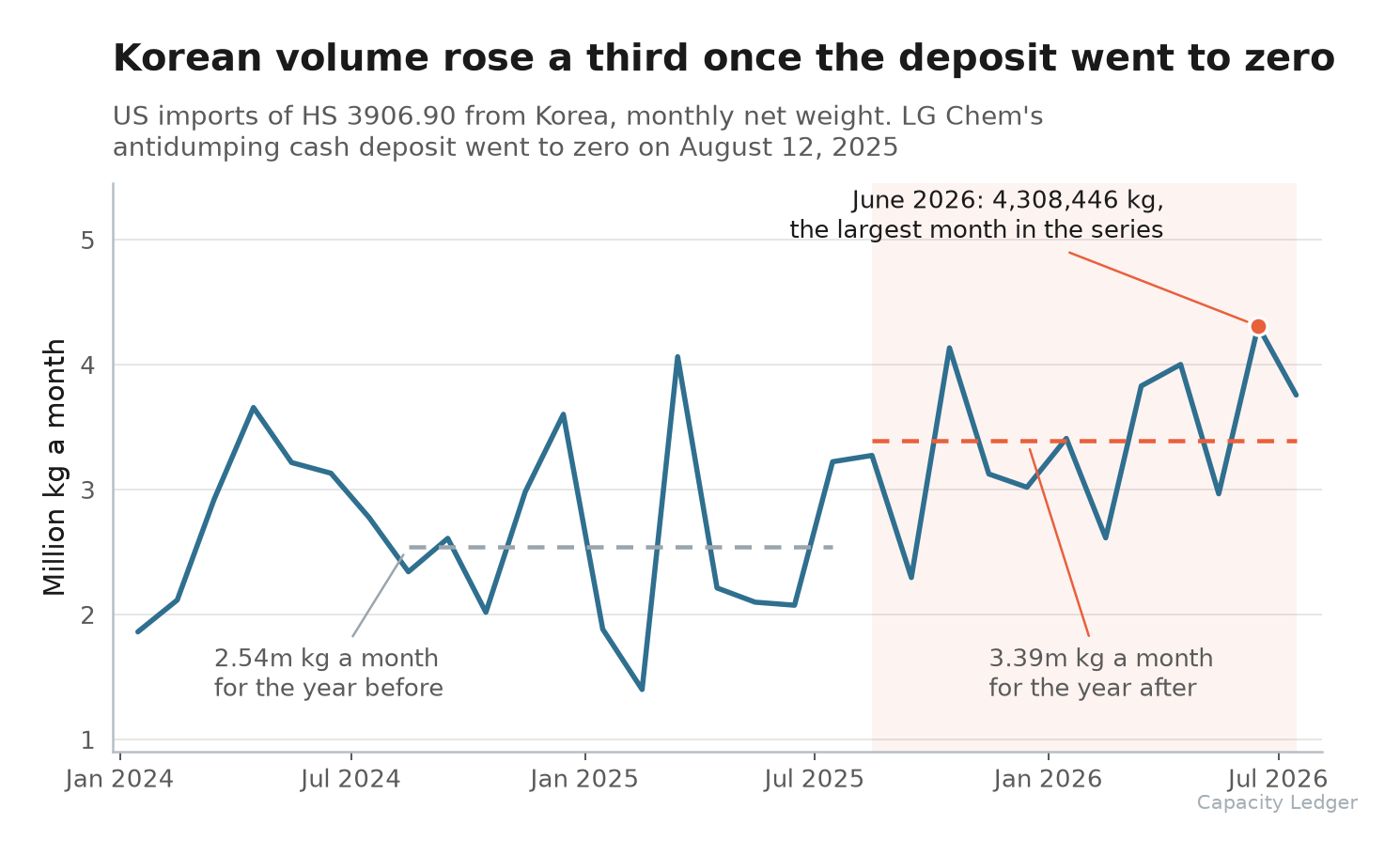
Price moved with it. Average customs value went $2.62 to $2.29 a kilo, down about 12 percent, on a Korean book worth $85.3 million last year.
None of which puts Korea back where it was.
The line ran 76.3 million kg in 2021 and 26.9 million in 2023, the first full year under the order, and 2024 and 2025 both settled near 33 million. The last twelve months put about 10 million kg back against a peak-to-trough loss of nearly 50.
Final Thoughts
Korea is the sixth-largest origin on this subheading by weight, 8.2 percent of it. Japan sits at 20.6 percent, and in the Federal Register's entire AD/CVD record there has never been a superabsorbent case against anyone except Korea.
So the single Korean order was never the whole import question, and it is now barely a cost question either.
The zero comes with a date on it. Commerce initiated a third review on February 20 covering December 1, 2024 through November 30, 2025, LG Chem again the named respondent, and the order's first sunset falls due in December 2027.
Trade remedies get filed as a fixed cost the moment the order publishes, and then they sit in the risk register at whatever number the investigation produced. This one has been quoting a rate nobody has posted since last summer, on a molecule whose duty math came down to how many ways a buyer is allowed to describe absorbency.
The order still stands and the next review can move it again. It just has not collected a dollar from LG Chem since last August.
Thanks for reading.