How a Take-or-Pay Tonne Floats Its Own Start Date
Smackover Lithium has now sold roughly 90% of its targeted offtake at South West Arkansas. Both contracts start on a date the filings moved back a year, and only one of them ends up with a company that actually consumes lithium carbonate.
Two binding lithium carbonate offtake agreements now sit on file at the SEC for the same Arkansas plant, and neither one names a date.
The Trafigura contract signed in March runs ten years "beginning at the start of commercial production." The LG Energy Solution contract signed on August 31 runs ten years "following the start of commercial production."
Same construction, same floating anchor.
"If a take-or-pay tonne starts whenever the plant starts, what has the buyer actually locked?"
Smackover Lithium, the partnership between Standard Lithium (55%) and Equinor (45%), told the market on Aug 31 that it has now committed roughly 90% of the offtake it is targeting for the first phase of its South West Arkansas project. That number is real and the milestone is real.
The same release moved something else.
What Actually Got Signed
Initial-phase nameplate is 22,500 tonnes a year of battery-quality lithium carbonate, and the partnership has said since March that it wants contracts covering "roughly 80%" of it. So the target is 18,000 t/yr.
Two agreements are signed, both binding, both take-or-pay, both ten years:
- Trafigura Trading LLC, 8,000 t/yr, announced Mar 9 2026
- LG Energy Solution, 8,000 t/yr, announced Aug 31 2026
That is 16,000 t/yr, which is 88.9% of the 18,000 target and 71.1% of nameplate. The company says it expects "one additional smaller agreement," which puts the last piece at roughly 2,000 t/yr.
Pricing in both is confidential and, in the releases' own words, "structured to support anticipated financing." Volume is what got disclosed.
Volume is also the only thing a take-or-pay clause secures when the delivery window is defined by an event rather than a calendar.
Big Enough That the Year Matters
US imports of lithium carbonate under HS 283691 came in at 15,853 tonnes in 2025, worth $162.9m. Argentina and Chile were 98.9% of that book between them.
China shipped 15.9 tonnes.
Go back eight years and the line barely moves: 11,663 t at the low in 2020, 17,245 t at the high in 2018, and nothing outside that band since (chart below). First-half 2026 annualises to roughly 12,600 t, so 2026 is tracking below 2025.
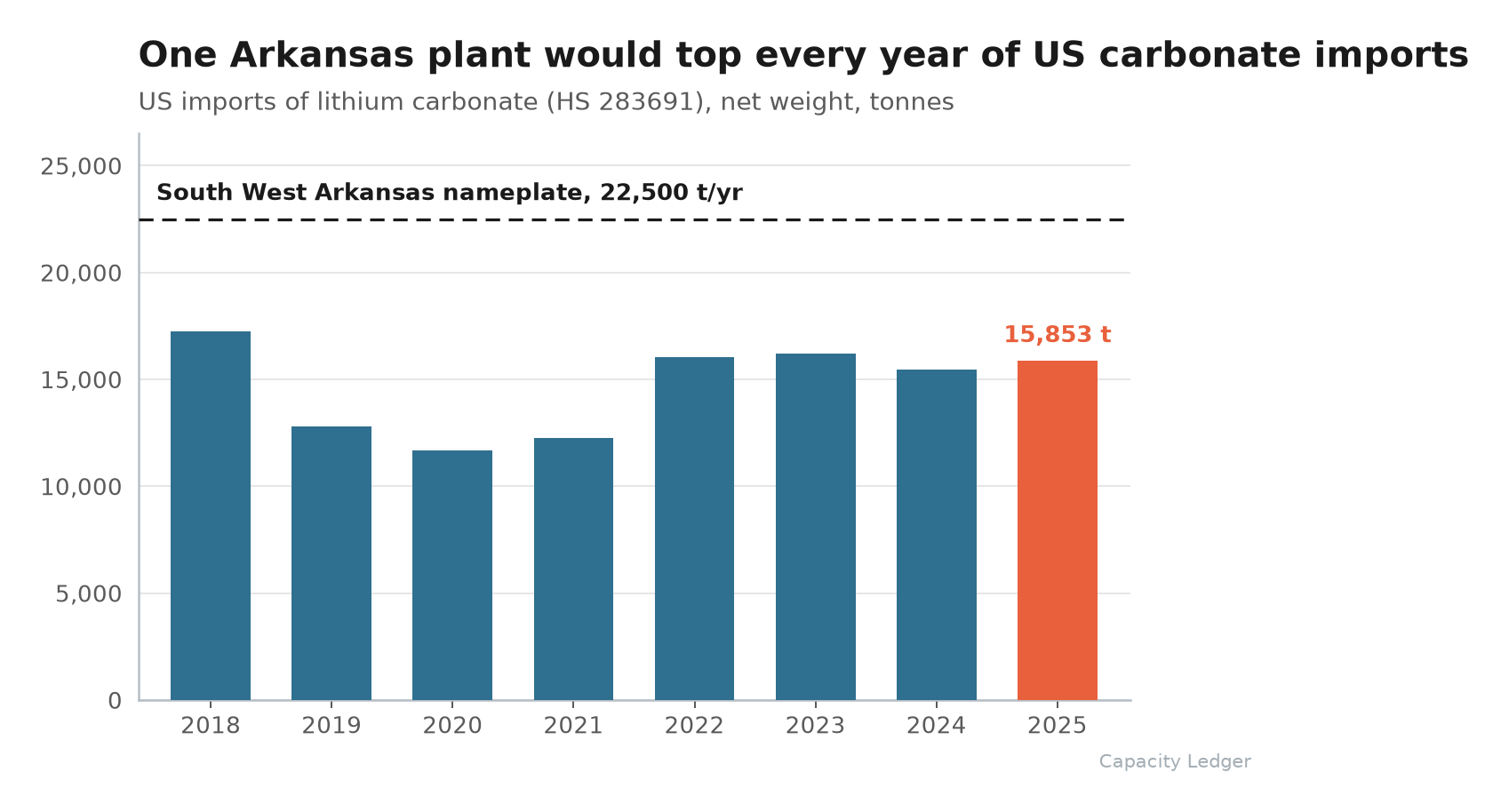
One plant at nameplate is 1.42x everything the United States imported of this molecule last year, and 1.30x the best year in the series. A plant that size resets the domestic balance on its own.
Which is exactly why its start year is the number worth watching.

The rest of this brief is for subscribers.
The capacity math, the trade-flow read, and what it means for the products you buy.
$50 a month, or $400 a year.
Already a subscriber? Sign in