How a Chemical Nobody Here Makes Gets a TSCA Rule
EPA put the ethylene dibromide draft risk evaluation out on August 19 and preliminarily found that 10 of 12 conditions of use significantly contribute to unreasonable risk. Every pound in the file is import volume, reported by two companies, and the demand base underneath it just printed its highest year since 2019.
In 1977 the United States made roughly 300 million pounds of ethylene dibromide, and about 93% of it went into fuel as a lead scavenger.
That was the whole business. Tetraethyl lead raised octane, EDB kept the lead from welding itself to your valves, and the two shipped together.
Then 1974 happened, then 1996, and lead came out of road fuel. What survived is a rounding error of the old volume, sitting in aviation gasoline and a few drums of racing fuel.
On Wednesday, August 19, EPA published the draft risk evaluation for that rounding error at 91 FR 53618 and started a comment clock that runs to October 19.
We logged the notice in Wednesday's radar as a three-line item. The part we skipped is the part that matters to anyone who buys the molecule.
"If EPA writes a section 6 rule on a chemical with no US plant behind it, who does the rule actually land on?"
Nobody Reported Making It
Go to the production-volume section of the draft and EPA answers the supply question in one sentence: "No domestic manufacture was reported under CDR for this period (i.e., total production reflects imports only)."
The period is 2012 through 2023. Twelve years, four Chemical Data Reporting cycles, and not one pound of reported US manufacture.
Later on, in the risk determination itself, the Agency drops the qualifier entirely: "Ethylene dibromide is not manufactured in the United States and is primarily imported to the United States at a concentration range from 30 to 60 wt% in TEL-B for fuel use."
And the reporting is thin in a way you should look at directly. Every volume EPA has for those twelve years came from two companies, named in the draft as Innospec Inc. and NewMarket Corporation.
Import was the only activity either of them left un-redacted. Everything else was claimed as confidential.
So EPA publishes ranges rather than numbers, and the ranges are what the chart below plots.
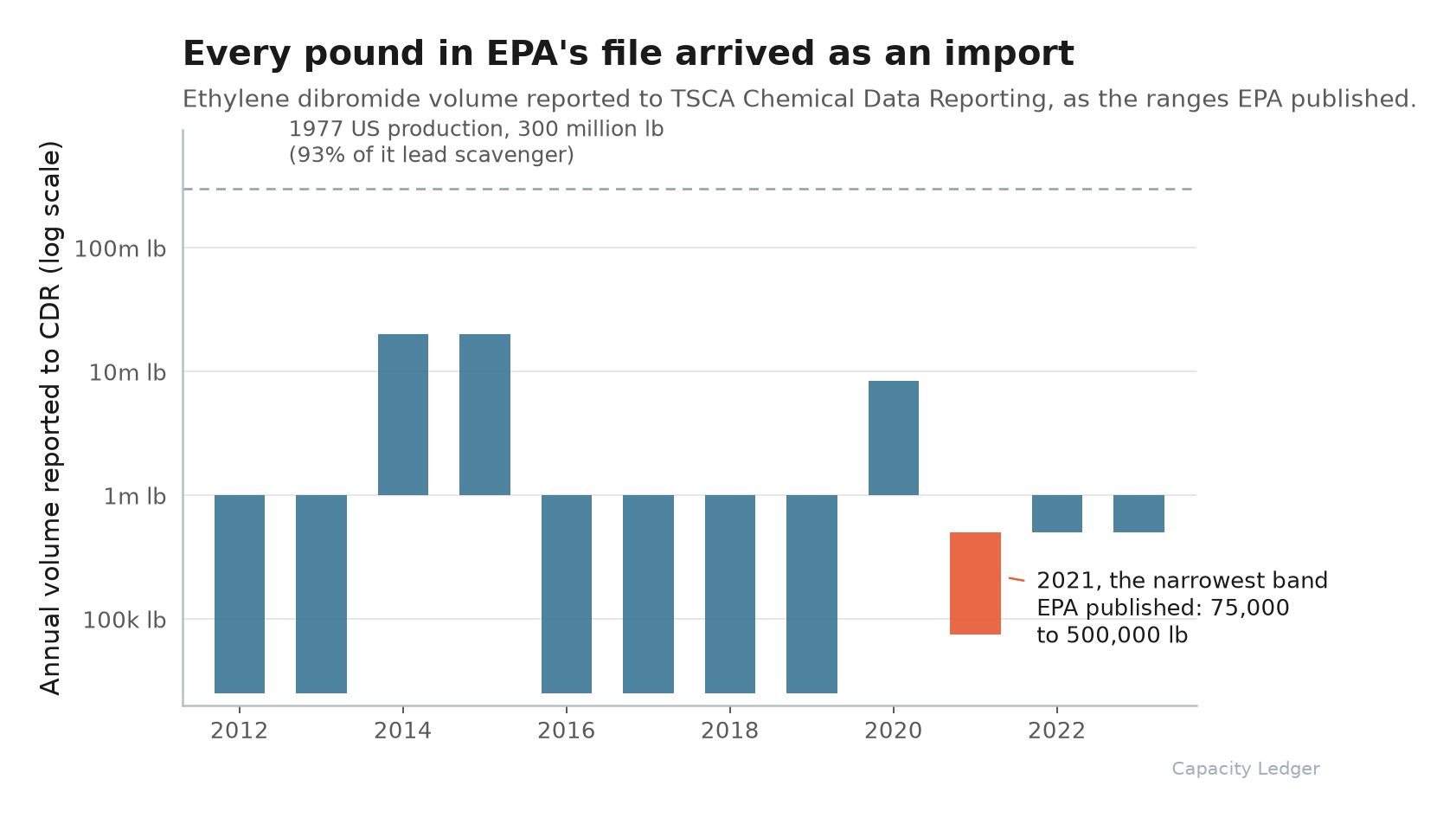
The shape tells you how little is moving. Under 1 million pounds a year in 2012, 2013, and again from 2016 through 2019. A spike to somewhere between 1 and 20 million pounds in 2014 and 2015. Then 75,000 to 500,000 pounds in 2021, the tightest band EPA published, and 500,000 to 1 million in 2022 and 2023. The 2024 cycle puts the annual national total back under 1 million pounds.
Against 300 million pounds in 1977, the entire current US supply of this chemical would fit in a few tank containers.

The rest of this brief is for subscribers.
The capacity math, the trade-flow read, and what it means for the products you buy.
$50 a month, or $400 a year.
Already a subscriber? Sign in