 Capacity Ledger
How a Custom Manufacturer Buys Its Own Demand
MFG Chemical closed its fourth acquisition in four years on August 12. The published capacity underneath all of it is twenty-six reactors and a gallon range, which is exactly why a closure-and-addition file never sees a company like this.
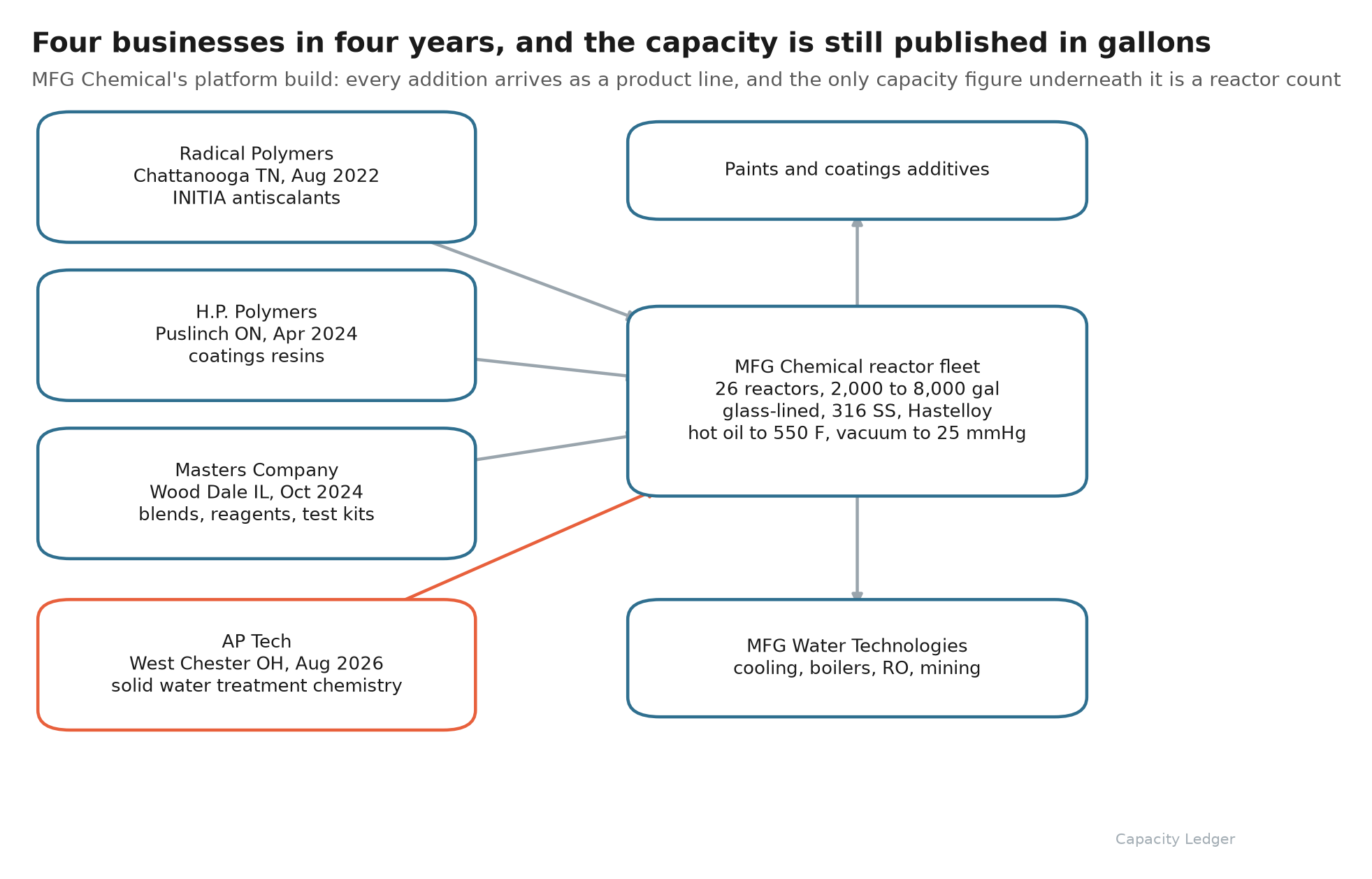
Twenty-six reactors, 2,000 to 8,000 gallons apiece, in glass-lined steel, 316 stainless and Hastelloy. Hot oil systems to 550°F, vacuum down to 25 mmHg, pressure to 100 psi, every reactor area rated for flammables.
That is the entire published capacity statement of MFG Chemical, and it is the most useful one we have read this month.
MFG is a private specialty and custom manufacturer, founded in 1980 and headquartered in Chattanooga. On August 12 it acquired AP Tech, its fourth business in four years.
Nowhere in any of it is there a tonne.
"What does it mean to add capacity when nobody pours concrete?"
What Landed on August 12
AP Tech is a West Chester, Ohio house founded in 1999 by Jim Heimert, and it makes solid chemistry for industrial water treatment instead of the liquid products the market mostly runs on. By MFG's account it now serves hundreds of water treatment service companies worldwide with proprietary solid technologies.
Terms were not disclosed, which is normal at this end of the market.
Katie Lee, AP Tech's CEO, put the logic plainly. The combined shelf carries "both liquid and solid water treatment solutions," so a service company can fit the chemistry to the application rather than to whatever its supplier happens to make.
AP Tech joins Radical Polymers (Chattanooga, announced August 2022, the INITIA antiscalant line, an AWT Supplier of the Year) and Masters Company (Wood Dale, Illinois, October 2024, blended products, reagents, test kits and ultra-concentrates). All three sit inside MFG Water Technologies, which sells into cooling towers, boilers, mining, reverse osmosis, geothermal and oil and gas, and which states that every product it ships is made in the USA.
Radical Polymers' founder, Mike Standish, runs that division as VP of Water Additives. He spent 36 years in water treatment additive design before it, at International Specialty Products and at National Starch's Alco Chemical business, and has served on AWT's board.
The Fleet Is the Whole Disclosure
Now, the part that matters to anyone keeping a capacity file.
Twenty-six reactors between 2,000 and 8,000 gallons bound the installed batch volume somewhere between 52,000 and 208,000 gallons. That is our arithmetic on their published range and not a company figure, and it is still a better handle on the asset than anything in the four acquisition releases combined.
Hot oil to 550°F is the tell for what runs in them: alkyds, polyesters, esterifications, imidazolines. Vacuum to 25 mmHg is the water and solvent strip that finishes the batch.
The reaction plants run on DCS with a data historian. Packaging covers rail cars, tank wagons, ISOs, totes and drums, which tells you the customer mix runs from a single drum of specialty amide to a railcar of polymer.
Four businesses in four years feed that fleet and the two divisions sitting on top of it, and the only capacity figure anywhere in the chain is a reactor count (chart below).
How the Addition Column Misses It
Here is the catch. Every one of those four deals added capacity to the US specialty market, and not one of them would show up in a closure-and-addition file built from 8-Ks, WARN notices and state permits.
The mechanism, in order:
- Buy a product line with its formulations, its brand and its customer list.
- Move what will move into reactors that are already installed, already permitted and already rated for flammables.
- Skip the permit, the groundbreaking and the release with a tonnage number in it, because none of the three is required.
- Watch utilization climb while nameplate sits still.
- Book the whole thing as an acquisition on undisclosed terms.
Owned product displacing toll work in the same vessel is a capacity event by any definition a buyer cares about. It changes who gets the gallons, what those gallons cost, and how quickly a competing formulator can get a slot.
Where the Sites Are
MFG's clearest site disclosure came in January, when Windjammer Capital bought the company from Platte River Equity.
That release names three plants in Dalton, Georgia, one in Chattanooga (Radical Polymers), one in Wood Dale, Illinois (Masters), and one in Puslinch, Ontario near Toronto, the former H.P. Polymers, a coatings resin maker for metal, wood, marine and coil that MFG bought in April 2024.
Pilot testing and product development sit in Chattanooga and Dalton, on a 100-gallon 316 stainless unit that also runs to 550°F. The step from that pilot into the smallest production reactor is a straight 20x, so a customer's scale-up data has exactly one jump to survive.
The quality system is certified to ISO 9001:2015, and Chemical Industry Review named MFG its Specialty Chemical Manufacturer of the Year for 2025.
Final Thoughts
Our file counts tonnes because tonnes are what public companies publish. A closure gets a number because a closure gets an 8-K, and an 8-K gets a nameplate.
Private custom manufacturers publish gallons, reactor metallurgy and a list of cities. That is a capacity statement too, and it moves for reasons the tonnage file cannot detect: a product line changes hands in Ohio, and a vessel in Dalton starts making something else on Monday.
Paul Turgeon has said what comes next, which is more of the same, and Windjammer bought the platform on that basis. If you are trying to work out who can actually make a specialty additive in North America next quarter, the equipment page is the document to read, not the filing that never gets written.
Thanks for reading.