How Low Water Curtails a Plant That Never Stopped
The Rhine gauge at Kaub is within a few centimetres of an all-time low, three months early, and barge freight to Karlsruhe has almost tripled since June. What that does to anything you buy from above the chokepoint.
Late on Tuesday, the gauge at Kaub read 29 centimetres.
We pulled that off the German waterways agency's own feed rather than off a wire, because the wires from two weeks ago are already stale. On July 15, when the Rhine made the front of every logistics newsletter, Kaub sat at 40.
Then the rain came. The gauge went to 81 on July 20, the recovery stories got written, and it has fallen every single day since (chart below).
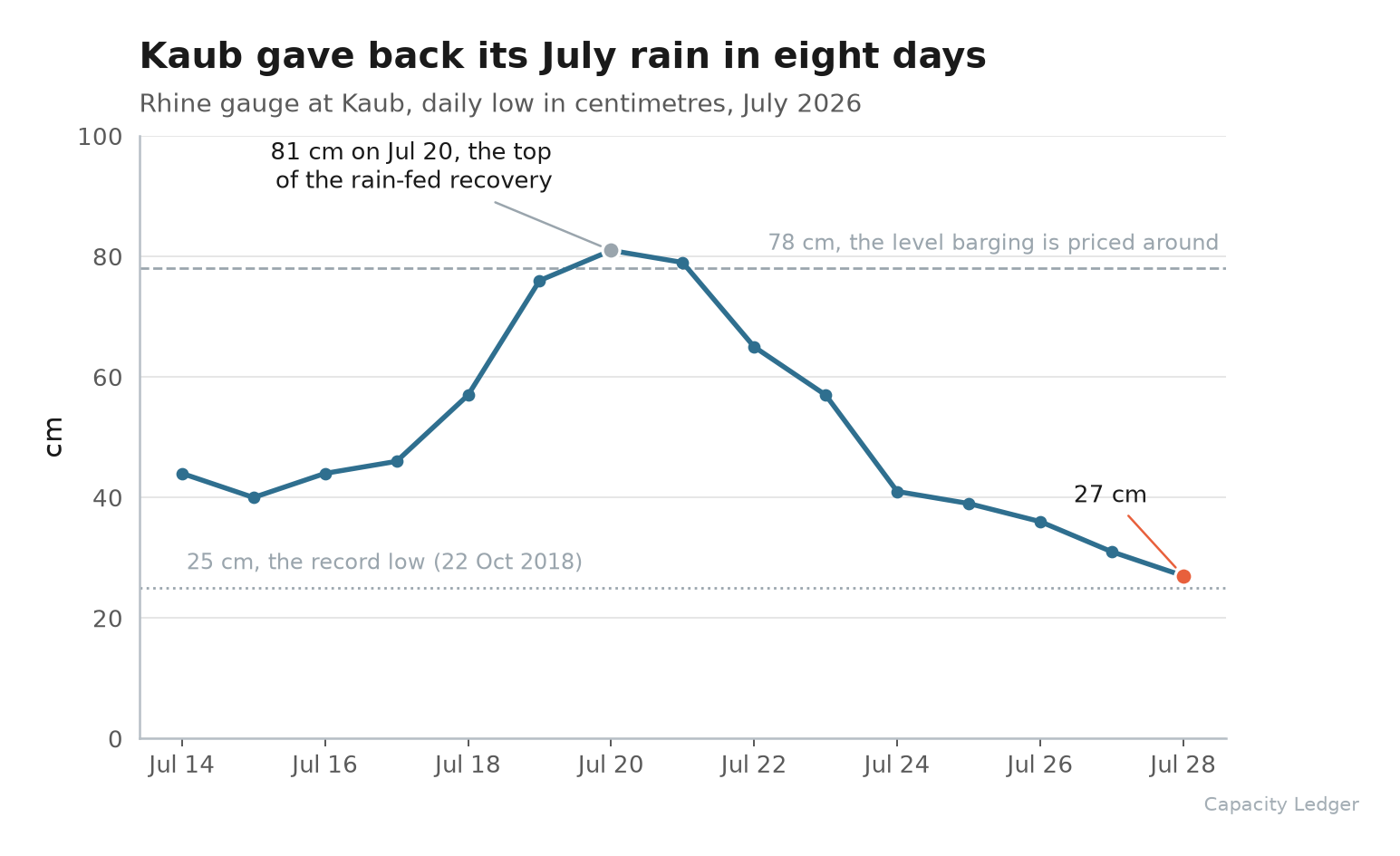
The record low at Kaub is 25 centimetres, set on October 22, 2018. That is the number the German chemical industry carries around in its head, and getting there took a drought that ran from August into November.
It is July 28. The waterways agency's Monday forecast has the gauge going from about 35 at the start of this week to around 20 by Friday.
"What do you do when the plant is running fine and the product still cannot reach you?"
The chokepoint does the rationing
Kaub is the shallowest stretch a vessel has to cross between the North Sea and the Upper Rhine. That is why BASF's Ludwigshafen site watches that one gauge rather than the river in general, and why a number measured at one narrow stretch of the Rhine Gorge sets the delivered cost of product made well upstream of it.
The gauge is not the depth. Navigable depth at Kaub runs gauge + 1.90 m − 0.78 m, so tonight's reading leaves roughly 1.4 metres of water under a hull that would normally have close to two.
So vessels load to draft instead of to capacity. Reuters had tanker barges taking about 1,200 tonnes through Duisburg and 460 at Kaub in the middle of the month, and by last Monday the traders were quoting 15% to 20% of normal load or less.

The rest of this brief is for subscribers.
The capacity math, the trade-flow read, and what it means for the products you buy.
$50 a month, or $400 a year.
Already a subscriber? Sign in