 Capacity Ledger
Squalane Waited 243 Days on a 120-Day Clock
The Foreign-Trade Zones Board told a North Carolina squalane plant on Tuesday that its February filing needs a full application instead. The regulation gives the Board 120 days to reach that answer and this one took 243. A Port Arthur refinery got the identical letter the same day, and the Board's fast-track docket has more than doubled this year.
A plant in Leland, North Carolina asked the Foreign-Trade Zones Board in February whether it could make squalane inside its own zone.
The answer arrived on Tuesday. 243 days after the question.
The regulation gives the Board 120.
What Aprinnova Actually Asked
The notification landed on February 26, and the Board put it out for comment a week later.
The proposed finished products were squalane, hydrogenated poly (C6-20 olefin) and hydrogenated difarnesene. The proposed foreign-status input was farnesene.
Every one of those four lines is duty-free, which rules out the obvious reason to want zone production authority. You cannot arbitrage a tariff inversion when both ends of the reaction already sit at zero.
The reason is in the next paragraph of the notice. The farnesene is exposed to section 122 and section 301 duties depending on where it comes from, and those decisions require the material to be admitted in privileged foreign status. PF status locks the classification and the rate at the door, so the zone cannot wash a duty off an input by converting it into something cheaper to import.
What is left is the export case and the deferral case, which for a hydrogenation line running imported feed is worth filing for. So they filed.
The comment period closed April 13. Then the file went quiet until October 27, when the Board notified the company that further review of the activity is warranted and that the production activity described in the notification was not authorized.
If Aprinnova still wants it, the notice says, it needs to submit an application for production authority under section 400.23.
Six months of silence, and the instruction at the end is to start again in the slow lane.
The Fast Lane Is Where Everyone Went
Pull every Federal Register notice the FTZ Board issued this year and the shape of the problem stops looking particular to one applicant (chart below).
Notifications of proposed production activity ran between 45 and 67 a year from 2021 through 2024, and 54 in 2025. This year, through October 30, there have been 125.
Ten months, 2.3 times last year's full-year count.
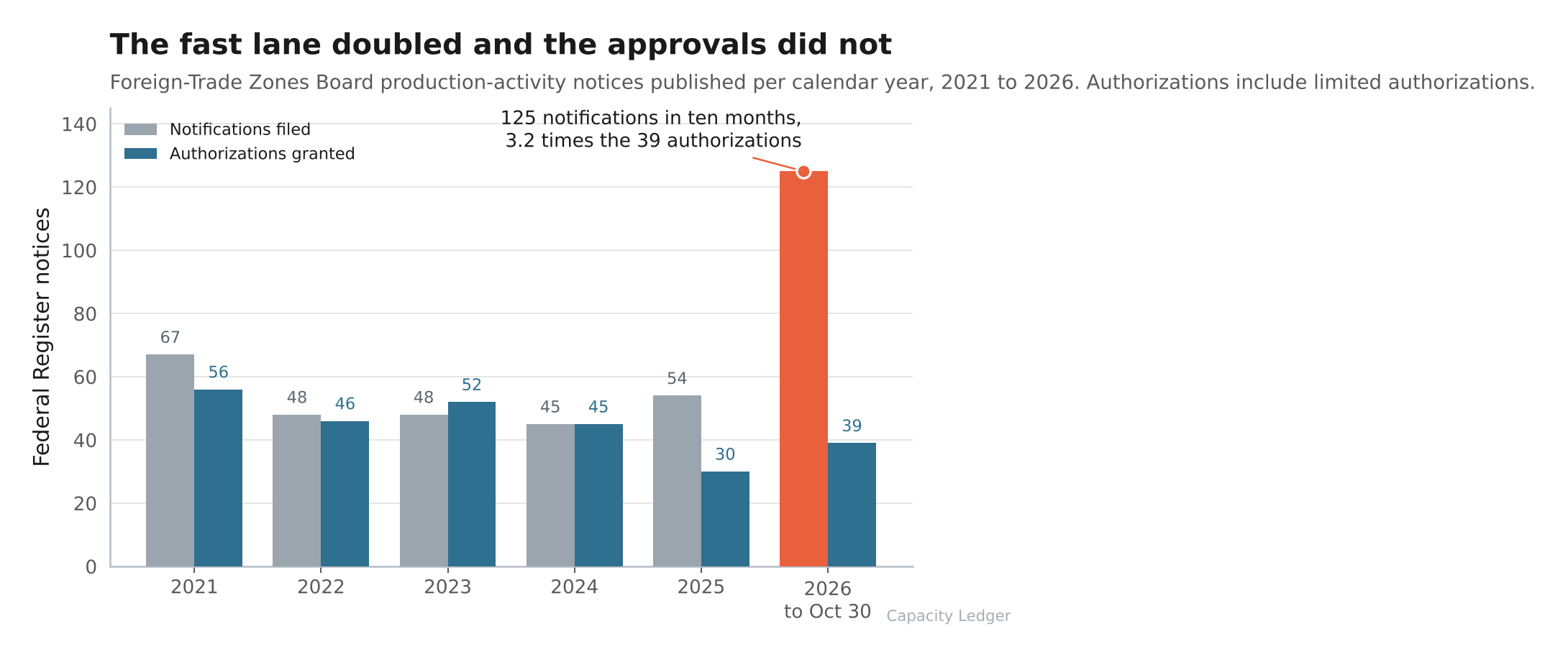
Authorizations out the other end: 39 so far in 2026, against 30 in 2025 and a 2021-to-2024 band of 45 to 56.
One honest caveat on that second series, because it matters for how hard you lean on it. An authorization published in a given year mostly disposes of a notification filed months earlier, so the 2026 bar will keep growing after the year closes.
The load on the docket is the real finding here, and the load is unambiguous.
What the Clock Is Made Of
The 120 days is not a target. It is built out of named steps in 15 CFR 400.37, and each one has its own number.
- The Executive Secretary sends the comment notice to the Federal Register within 15 days of starting to process the notification.
- The comment period normally closes 40 days after that notice appears.
- Within 80 days of receiving the notification, the Executive Secretary recommends to the Board whether further review is warranted.
- Within 30 days of getting that recommendation, the two Board members return their determinations.
- Within 120 days of receipt, the Executive Secretary tells the filer which way it went.
Aprinnova's 120-day date was June 26. The letter came 123 days past it.
And it was not alone on the desk that afternoon. Valero Energy filed on behalf of The Premcor Refining Group for renewable fuels production in Subzone 116C at Port Arthur on March 10, drew the same determination on the same October 27, and ran 231 days against a 120-day date of July 8.
Two notices, consecutive document numbers, one morning's Federal Register.
Final Thoughts
Three cases have come out of the notification route unauthorized this year, against two in each of 2024 and 2025, so the denial rate is not what changed. The waiting is.
Section 400.23 is where both of Tuesday's filers now go, and that route budgets 150 days for the examiner's report after comments close, 45 days for an applicant to answer an unfavourable preliminary recommendation, and another 30 days of comment with 15 for rebuttal if new evidence shows up along the way. Budget a year, and budget it from the day you file rather than from the day you hear back.
If you are modelling landed cost on a duty-exposed input feeding a zone operation, the filing date stopped being the start of a four-month window some time around February. Price the input as though the zone treatment is not there yet, because for 125 filers this year, it is not.
Thanks for reading.